Arthur Cox and the National Pensions Summit
The Business Post National Pensions Summit is the leading forum for Irish pension decision makers to gather for networking and insights in the design and delivery of pension plans for Ireland’s increasing workforce.

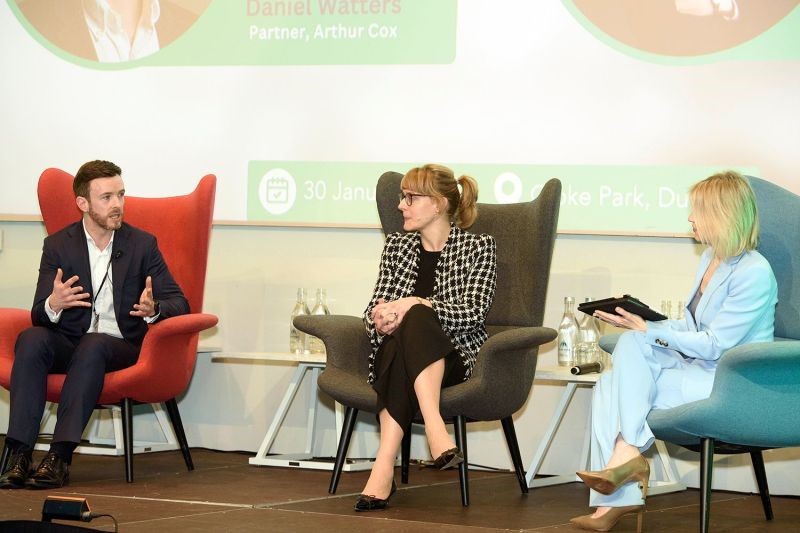
As part of the event, Daniel Watters (Partner) and Sarah McCague (Partner) from our Pensions and Employee Benefits Group will host a session, titled ‘Looking to the future: Key Legal and Regulatory Changes for Irish Pensions in 2026’. They will provide practical insights into the latest developments that are shaping the Irish pensions landscape, including:
- Emerging legislative trends at Irish and EU level, such as the pension schemes authorisation regime, anticipated legislation concerning mandatory retirement ages and PRSAs
- Key regulatory updates, including SRP, in-scheme drawdown, and the outcome of the DB consolidation review
- Practical insights into the roll out of auto-enrolment regulations
You can view the full agenda for the day by visiting the National Pensions Summit website
What to expect in 2026
Our Pensions and Employee Benefits Group has put together a summary of key developments that are expected to influence the pensions industry in 2026:
Automatic enrolment
The automatic enrolment (AE) system came into force on 1 January 2026. Employees aged between 23 and 60, who earn in excess of €20,000 gross per year (from all employments) and who are not already enrolled in an occupational pension scheme or other pension arrangement, will be automatically enrolled into “My Future Fund”, the fund set up by the Government to accept AE contributions.
Employers whose employees are currently participating in an occupational pension scheme or PRSA should note that the Government has introduced regulations setting minimum standards for such schemes/PRSAs in order for their members to qualify as being in exempt employment. For defined contribution schemes and PRSAs, employer contributions must be at least 1.5% of an employee’s gross pay or €1,200 per year (whichever is less) and combined total employer and employee contributions must be at least 3.5% of gross pay or €2,800 per year (whichever is less).
For defined benefit schemes, continued service in employment must entitle the employee to accrue a “long service benefit”. If a scheme or PRSA does not meet the new contribution standards, both the employer and the employee will be required to contribute to the AE system separately and such contributions may be in addition to continuing existing contributions to the scheme/PRSA.
Introduction of Pension Scheme Authorisation Regime
In a number of public statements throughout 2025, the Pensions Regulator indicated that the Pensions Authority (the Authority) were liaising with the Department of Social Protection to prepare legislation that would introduce a new authorisation regime for occupational pension schemes in Ireland.
The Government’s 2025 Autumn Legislative Programme includes an “Occupation Pensions (Amendment) Bill” which is stated to be intended “to develop detailed policy and legislative proposals relating to the regulation and supervision of Master Trust pension schemes and to ensure the appropriate statutory protections are provided for these schemes”.
Although the Legislative Programme refers solely to master trusts, statements from the Pensions Regulator have indicated that “it is intended that all funded retirement schemes will be subject to authorisation, based on the requirements of IORP II and an enhanced version of the Code of Conduct.”. The timeline for the implementation of the authorisation regime is unclear, but if introduced in 2026 it is likely to introduce a significant additional layer of regulation for all occupational pension schemes as there has been no indication of any grandfathering provisions in relation to existing pension schemes.
Introduction of in-scheme drawdown
The Authority is currently consulting on the possibility of introducing “in-scheme drawdown” (ISD) for defined contribution (DC) pension schemes.
The proposed in-scheme drawdown (ISD) arrangement will permit DC scheme members to retain and draw down the balance of their fund within the scheme post-retirement, following the payment of a lump sum. ISD will be optional for schemes and will not replace existing retirement options. The retained balance will constitute a vested retirement benefit.
ISD does not involve guarantees, does not require a separate ring-fenced fund, and the member remains part of the scheme until all assets are drawn down. Trustee obligations continue until the member ceases to hold assets in the scheme.
The consultation closes on 20 January 2026 and the Authority is likely to introduce its proposals for ISD shortly thereafter. The Authority’s consultation paper is available here.
Please contact a member of our Pensions and Employee Benefits Group for more information.
Updates from our Pensions and Employee Benefits Group






Our Team

Philip Smith
Partner | Dublin | Pensions and Employee Benefits
Deirdre Cummins
Of Counsel | Dublin | Pensions and Employee Benefits
Michael Shovlin
Of Counsel | Dublin | Pensions and Employee Benefits
Katie Lawless
Senior Associate | Dublin | Pensions and Employee Benefits
Ross Neill
Senior Associate | Dublin | Pensions and Employee Benefits