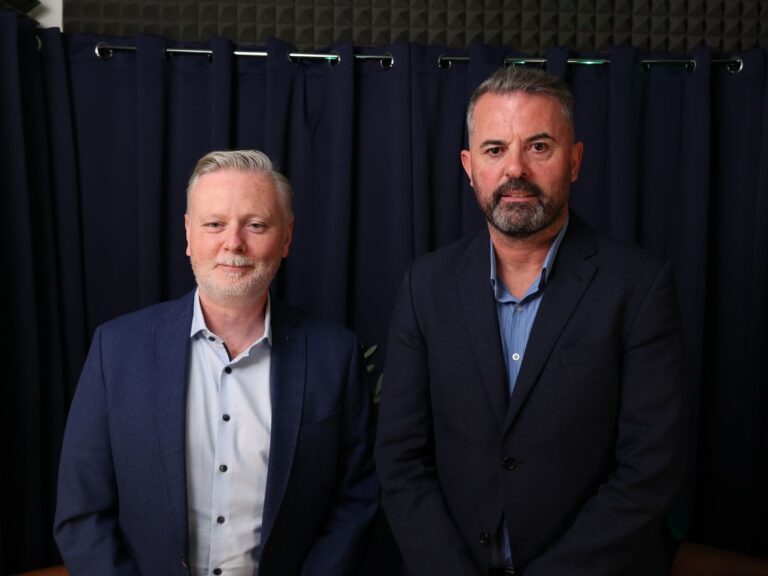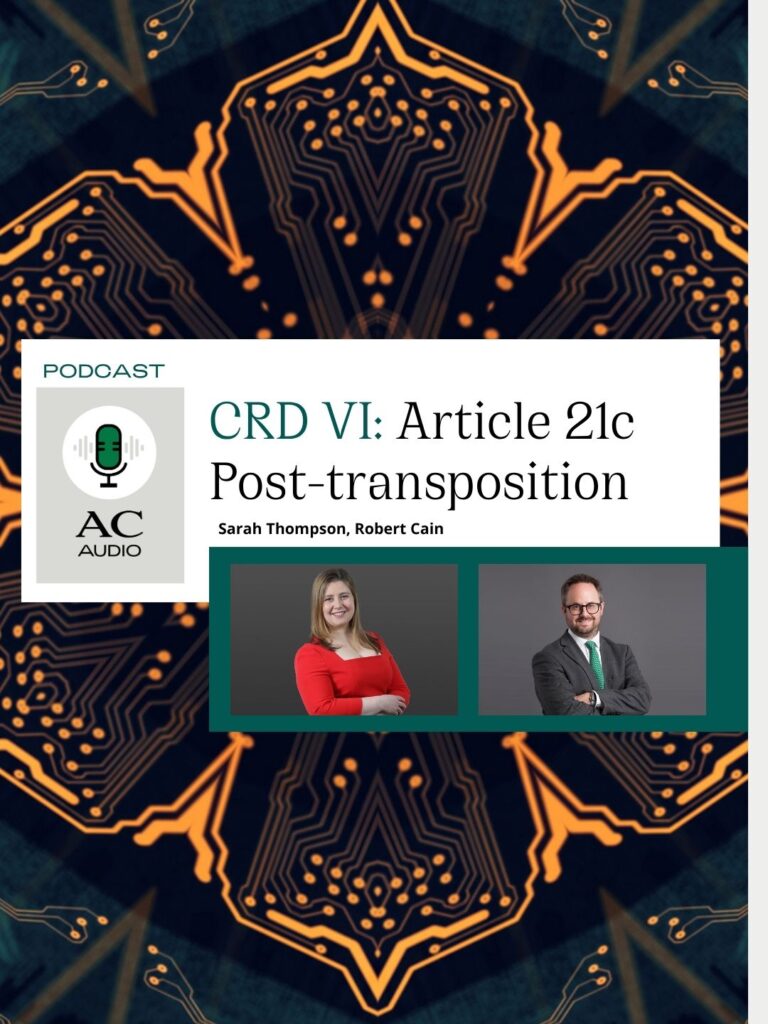
In this episode of our podcast, Rob Cain, Partner, and Sarah Thompson, Partner and Head of the Financial Regulation Group, discuss the implications of the recent Irish transposition of CRD VI, with a particular focus on Article 21c and its impact on cross-border lending into Ireland.
Rob and Sarah examine key issues arising under the new regime, including the operation of the reverse solicitation exemption, the Irish transposing measures and the practical challenges facing third-country institutions providing financing to Irish borrowers. They also explore the developing market approach to grandfathering, lifecycle events and amendments to existing lending arrangements, considering the wider implications across a range of sectors, including funds, aviation finance and structured finance.
Podcast Transcription
Rob Cain
Hi there. My name is Rob Cain. I’m a partner in the Financial Regulatory Group at Arthur Cox, and I’m joined today by my partner Sarah Thompson, who’s also in the Financial Regulatory Group. This is our second podcast on Article 21c of CRD VI. The first one that we did was pre-transposition. This one is post-transposition. We had transposing measures on the 14th of July.
Sarah Thompson
And I think, Rob, some key things to note from the transposing measures. Obviously, CRD VI and the 21c prohibition represent a significant change for the Irish market, particularly in the regulation of commercial lending. So, as one of the most exposed member states, we had perhaps had the hope, the expectation, that the transposing measures would reflect perhaps a departure from the approach that Ireland has traditionally taken to transposing directives.
Rob Cain
Just a copy-out.
Sarah Thompson
Exactly. That opportunity was not taken. And so the transposing measures for Article 21c very much follow the CRD VI text.
So what does that mean? In some ways it’s helpful because it means we are not working with a set of rules that in any way diverges from the European text. So we should be looking at a consistent approach across the European Union, and nothing about the Irish measures should result in Ireland taking a path that others are not taking, or which will be brought back by the European bodies at some later date.
But I think some of the pieces that still remain are, you know, what does ‘in the State’ really mean in Ireland? And we’ve been discussing that with clients quite a bit over the last few weeks, in particular in light of the CBI’s Brexit guidance and their approach to assessing whether a third-country institution is providing services to Irish clients. Those considerations continue to be relevant, and nothing about the transposing measures has indicated to us that we should stop thinking about that in this particular way. Even if, in Ireland, our characteristic performance analysis doesn’t look the way it does in Luxembourg, for example, it’s still there.
Rob Cain
That makes sense. We said we’d sort of talk about reverse solicitation to kick things off, and that’s a really, really important exemption, one that I think people can rely on significantly. But I think there’s a question: is it really workable? Or is reverse solicitation going to be a bit of a minefield?
Sarah Thompson
Well, I think it’s going to be mission-critical for market participants in Ireland, and it’s going to be really important for anybody who’s looking to provide financing-type products to Irish borrowers in particular. I think we, reverse solicitation as a concept, is not new. We’ve seen it in the context of other regimes, but it is new in the Irish context for banking services. And so we are in somewhat of new territory. But I think it’s important that reverse solicitation is, in fact, in the text of the transposing measures and in the directive. It’s black-letter law.
Rob Cain
Yeah.
Sarah Thompson
So you can rely on it. It is the law that it is available. There has to be some care around using it, particularly in a global institution context. So it’s taking care that while the third-country institution that is subject to the general prohibition may not have solicited the Irish customer, the Irish client, it’s whether there could be a view that another member of the group has done the solicitation on behalf of that third-country institution.
So there are a few, I suppose, parameters to bear in mind to get full use out of reverse solicitation and not inadvertently lead yourself to tripping up over the general prohibition where there’s no need. And I think with that in mind, sort of two key practical takeaways that we’re discussing with clients quite a bit, and that’s documentation. So throughout a relationship, or throughout a new line of business or a new transaction with a counterparty, it’s keeping that record. It’s making sure that you have all the call notes and emails that you need to evidence reverse solicitation later.
I think the other piece is, particularly in the syndicated lending scenario, maintaining clear delineation between the roles of the various parties.
Sarah Thompson
So it’s making sure it’s clear who is doing work on behalf of whom. So, for example, if you’ve got a facility agent in the middle, it should be clear that they are acting on behalf of the borrower and they’re not acting on behalf of the lender population. So there’s no suggestion that either the agent is soliciting on behalf of the lenders. In fact, they are working with the borrower to put the syndicate together.
Rob Cain
And that’s a big change, isn’t it? Because we don’t regulate commercial lending at the moment. So you might be able to get to the same place as a lender, but it’s thinking about those practical points to get you there, to get you within the scope of the exemption.
Sarah Thompson
Exactly. I think in Ireland too, the key thing we need to remember is that there was no Central Bank of Ireland guidance with the transposing measures, and indeed we’re not expecting any to come any time soon. And so, in the absence of that regulatory guidance, it’s over to the market to fill the gap.
And I suppose part of the purpose of this podcast is just to make our listeners aware that we are talking to folks across the market about this. So if it would be helpful to talk through your thinking on how market practice is developing, what practical guardrails you can put in place for your business colleagues, we’re more than happy to discuss that because we have a great view of what market practice is emerging in the use of reverse solicitation.
Rob Cain
Yeah, exactly. And also a view across other EU member states as well, talking to colleagues in other jurisdictions. Moving on from reverse solicitation, let’s chat about grandfathering for a second. That feels like we shouldn’t be talking about it because it’s been and gone.
Sarah Thompson
Yes.
Rob Cain
But still relevant.
Sarah Thompson
Definitely. So the 11th of July has been and gone, and now we’re living with the consequences of that. So if you are looking at your agreements that are benefiting from grandfathering, two points to be aware of as we go forward.
So it’s the lifecycle events piece. So anything that’s materially changing about your agreement, you have to have a care as to whether you could potentially have a loss of grandfathering. So things like increasing the committed amount, increasing the term, everything should be considered. I suppose it’s not an automatic loss of grandfathering. I would say it can depend on whether there’s an inbuilt mechanic in the pre-existing agreement. It’s whether there’s any discretion outside the agreement for the change. So when you look at all of those things in the round, you may well not be losing grandfathering.
So that’s the first one, lifecycle events.
Rob Cain
And a lifecycle event is effectively something that happens during the life of the loan, a change that occurs. Exactly.
Sarah Thompson
The other piece is drawdowns. So, as with grandfathering, it in many ways felt like it was designed to cover a straight bilateral loan that was advanced, paid back in instalments, and then we all move on. And that’s just not the commercial reality of a lot of what we’re looking at. So for any agreement, any facility that has a revolving element or involves drawdowns at a later date, it’s looking at whether that mechanic has an impact on the grandfathering analysis. It’s less mission-critical between now and the end of the year, but from January, I think that’s going to be really important to the licensing analysis.
Rob Cain
Yeah. We spend a lot of time advising clients. I’m using the royal “we” here. You have, Sarah, advising clients on these two points, haven’t you?
Sarah Thompson
Yes.
Rob Cain
We spend a lot of time on that and getting into the weeds on multiple different types of lifecycle events.
Sarah Thompson
Exactly. There isn’t a blanket answer in a podcast. Please do give us a call, I suppose, is what we’d say. If you have questions, it’s always worth a look.
And on that note, those are sort of two notes of caution. I think it’s important to have a note of comfort as well, in that the other exemptions sit alongside grandfathering. So even if you lose grandfathering, another exemption may be available. The one that springs to mind is reverse solicitation.
Exactly. So the example we were just giving, if the borrower has asked for an extension of the term on the facility, query whether that can in fact benefit from reverse solicitation, even if acceding to that request could result in the arrangement losing grandfathering. So all is not lost.
Rob Cain
And a lifecycle event is effectively something that happens during the life of the loan, a change that occurs.
Sarah Thompson
The other piece is drawdowns. So, as with grandfathering, it in many ways felt like it was designed to cover a straight bilateral loan that was advanced, paid back in instalments, and then we all move on. And that’s just not the commercial reality of a lot of what we’re looking at. So for any agreement, any facility that has a revolving element or involves drawdowns at a later date, it’s looking at whether that mechanic has an impact on the grandfathering analysis. It’s less mission-critical between now and the end of the year, but from January, I think that’s going to be really important to the licensing analysis.
Rob Cain
Yeah. We spend a lot of time advising clients. I’m using the royal we here. You have, Sarah, advising clients on these two points, haven’t you?
Sarah Thompson
Yes.
Rob Cain
That makes sense. We might turn on to, we talked already about some of the questions we’ve been dealing with with clients. We’ve had a lot of queries, inbound queries from our funds, aviation and debt finance, and structured finance colleagues, so we thought we’d maybe just touch on some of the knock-on effects that we’re seeing at the moment, because it’s probably fair to say 21c doesn’t just hit standard corporate lending, its ripples go all over the place, particularly given we have such a large SPV and funds industry here and a lot of inbound credit from outside the EU.
Sarah Thompson
Absolutely. And perhaps the first place we start is sort of in the funds space, and in particular, the wrinkle that has persisted with the MiFID exemption. So we’ve talked a lot about the reverse solicitation exemption. The MiFID exemption deserves some time.
Rob Cain
Yes.
Sarah Thompson
So, as we know, the text of 21c in the directive itself only covered those Section A services in MiFID, so those investment services and activities, and it was silent as to the ancillary activities. There was very much a feeling that that was a drafting error and actually that Section B should have been explicitly included. There had been talk of a correction, if you like, being made through the Q&A tool, for example. So far, no sign of that.
The other route to a solution was perhaps in the transposing measures where the Department of Finance could have taken the opportunity in the statutory instrument to add that reference in. And we have seen that in other member states. But that opportunity was not taken.
But nevertheless, with that note that it has happened in other member states, it maybe illustrates the overall approach that should be taken on a European-wide basis, that the Section B services were intended to be included. And when you look at the language of the MiFID exemption in the round, I think there’s a very reasonable basis to proceed on that basis.
Rob Cain
Yeah, and you would have thought that if the Commission really didn’t like the position that a number of other member states are taking, I mean, we would have known about that.
Sarah Thompson
Exactly.
Rob Cain
They wouldn’t have done it if the Commission wasn’t sort of tacitly supportive of that position.
Sarah Thompson
Exactly.
Rob Cain
So we copied out, so we didn’t sort of make the correction. The question would be, what does market practice, or even what does the Central Bank confirm to firms as the correct position?
Sarah Thompson
Yes, because it doesn’t maybe take the form of a guidance note, but it will come in the form of, in their supervisory practices, are they making any comments that suggest a different approach?
So that’s the fund side. The other piece, aviation finance, a place where Ireland is a global leader, and there’s multiple touchpoints for CRD VI in the aircraft leasing and finance space. So we’re working with clients to work through each layer of an aircraft financing deal to make sure that we are picking up each of those Article 21c implications. Crucially, not just in the banking service of lending, but also that banking service of guarantees and commitments.
Rob Cain
I was going to say, in sort of letters of credit and stuff like that, it’s really, really pivotal in the aviation space.
Sarah Thompson
Yes, but not insurmountable. Again, I think, again, that note of comfort, there’s a way through, and we’re working with clients to find those ways through.
And I think too, the structured finance piece, so a plain vanilla securitisation shouldn’t be too much of a concern around 21c. But again, if there are some of those fiddlier pieces of it, I suppose we’re just working through the analysis on that. But by and large, it all seems to be falling into place with, I suppose, relative consensus in the market, could I put it that way, in the way through.
Rob Cain
We’ve also seen, I think, on the structured finance side that sometimes you have loans, but also sometimes you have sort of loan notes or equity.
Sarah Thompson
Yes.
Rob Cain
And so we’ve had some clients looking at that question of loans versus transferable securities. Transferable securities not caught by 21c, loans are. So some structuring sort of solutions in that case.
Sarah Thompson
And maybe that brings us neatly on to that last topic that we were going to discuss, is, okay, solutions to this problem. And that’s definitely one. What we’re seeing is where a loan note is more appropriate and therefore falls outside the banking services definition.
Rob Cain
You’re in a better position if you’ve always issued loan notes. There’s a process of switching from loans to loan notes. But in any event, we’d be reasonably comfortable that they’re transferable securities, so no problem.
Sarah Thompson
Exactly. There is a, as you say, there is an anti-avoidance point there. But if it’s something you’ve always been doing, I don’t think there’s really a pause there.
Other sort of solutions. So lenders that aren’t credit institutions. Yeah. So it’s an easy one to forget sometimes when you’ve been talking about 21c an awful lot, is that the restriction applies to third-country undertakings that are essentially third-country credit institutions or very large investment firms that deal on their own account.
So there are solutions where actually the lender is a different type of entity. So that’s one we’re seeing clients consider.
And also, as with that more general structuring solution, looking at a layer where a loan goes to an SPV and then there is on-lending, for example.
Rob Cain
That should be fine, where the on-lender is not a credit institution.
Sarah Thompson
Exactly. So a number of structuring solutions that we’re working through with clients on all of those things.
Rob Cain
Excellent. Thanks, Sarah. So lots and lots going on at the moment. We’ve been really, really busy with inbound queries on all sorts of things, CRD VI, Article 21c related. If you do need any advice or support on any questions that you might have on this topic, please contact either me or Sarah. Thank you.
Podcasts
The Arthur Cox podcast series ‘AC Audio’ is a collection of knowledge and insights across a range of practice areas within the firm. |
 |
 |
 |
Disclaimer: The contents of this podcast are to assist access to information and do not constitute legal or other advice. Specific advice should be sought in relation to specific cases. If you would like more information on this topic, please contact a member of our team or your usual Arthur Cox contact.