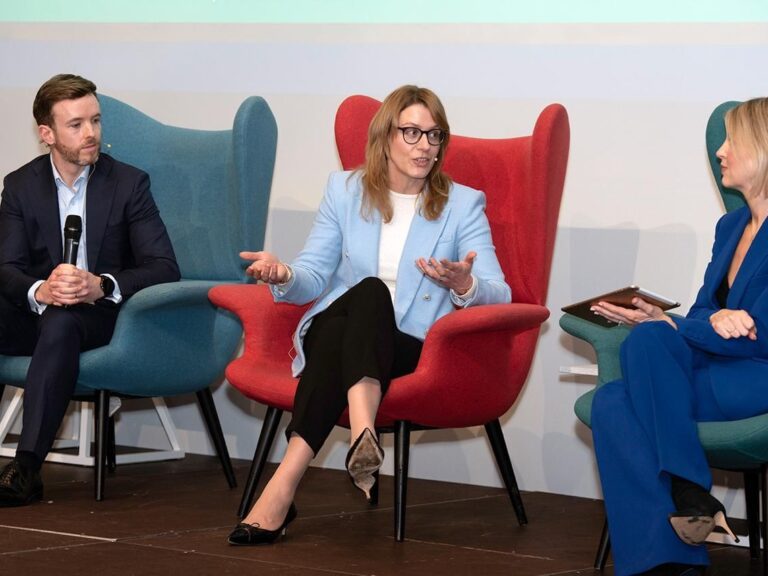


Partners in our Pensions and Employee Benefits Group, Sarah McCague and Daniel Watters spoke at the National Pensions Summit 2026, held in Croke Park on 28 January 2026 on the topic of “Looking to the future: Key legal and regulatory changes for Irish pensions in 2026”.
The session provided an overview of recent legal developments in the pensions sector and looked ahead to upcoming legal and regulatory changes likely to affect pension schemes this year and how both employers and trustees can prepare.
The Pensions Authority Supervisory Review Process (SRP) explained
Sarah was first asked about the Pensions Authority (the “Authority”) Supervisory Review Process (“SRP”), which she said is an example of the Authority using its powers of prudential supervision, introduced under the IORP II regime. She noted that there are five stages to the review process:
- An initial letter and questionnaire issued by the Authority to the scheme’s trustee board;
- A response from the Authority with further scheme specific questions;
- A meeting between the trustee board and the Authority;
- The Authority issuing preliminary findings to the trustee board, with an opportunity for a response from the trustee board
- The Authority issuing a final report.
Sarah noted that there are six key areas of focus for the Authority, namely governance, operations, risk management, communications, investment & fees, and charges. For DB schemes, there is an additional area of focus on funding matters. Sarah said that Arthur Cox has been working with many clients engaged in the SRP, including by preparing responses to the queries from the Authority and engaging in preparation sessions for meetings with the Authority. She noted that where a scheme is well run, the SRP should not identify any major red flags but that it is important for scheme trustees to engage with advisers to navigate the process.
Implications of new auto-enrolment regulations
Daniel was asked about pensions auto-enrolment and the new regulations which took effect on 1 January 2026 and which set out minimum standards for occupational pension schemes to categorise employees as being in “exempt-employment” for the purposes of auto-enrolment. He said that in the case of defined contribution schemes a total minimum contribution of 3.5% of gross salary or €2,800 per year (whichever is lesser) will be required with at least 1.5% (or €1,200 per year) being paid by the employer.
In the case of defined benefit schemes, schemes which confer a long-service benefit on members will result in those members being in exempt employment. Daniel noted that there are a number of areas that still need to be explored in practice such as the use of gross pay as the basis for contribution calculation, timing concerns in relation to employers’ ability to introduce changes to pension schemes in short order, and the potential for double deductions where employees in occupational pension schemes are deemed not to be in exempt employment.
Late retirement developments
Sarah was also asked about late retirement. She said that there is a changing environment in relation to retirement, particularly in the context of the enactment of the Employment (Contractual Retirement Ages) Act, 2025 (the “Act”). She said that employers will need to look at their practices in how they address requests from employees for later working. The Act will move to a consent-based approach where an employee’s contractual retirement age is less than the State pension age (currently 66) and will give employees the option to request to remain in employment up to State pension age.
Sarah noted that under the current law, an employer must demonstrate that the employee’s retirement age is objectively and reasonably justified by reference to a legitimate aim, which aim must be proportionate and necessary, and that once the Act is commenced, it is likely to become more difficult to meet such a test. She said that the Act has not yet been commenced but her understanding is that the Workplace Relations Commission is currently updating its Code of Practice on Later Working and that the commencement of the Act may be timed to coincide with the publication of the updated Code of Practice.
Overview of in-scheme drawdown
Finally, Daniel was asked about in-scheme drawdown which was widely discussed during the Pensions Summit 2026 and also pensions litigation. He noted that the Authority had recently run a consultation on in-scheme drawdown and said that there is a sense that the market generally views it as a positive from a member perspective, and that it is essential to keep the system’s design simple to allow members to easily compare options. On pensions litigation, he noted that the Arthur Cox Pensions and Employee Benefits Group have seen an increase in the number of claims in recent times. In particular, he noted an increase in claims relating to pension increases in a DB scheme context, while on the DC side, there has been growth in claims brought around the timing of investment switch instructions.
If you have any questions in relation to any of the topics discussed at the National Pensions Summit, please contact Sarah McCague, Daniel Watters or your usual contact in our Pensions and Employee Benefits Group.